
What is ReputeCast
ReputeCast is an open-source, self-hosted newsletter platform for newsletters, email marketing and product email. You run it on your own server, it sends through the sending provider you already trust, and it checks whether your mail will reach the inbox before you send, then guards your sender reputation while it sends.
It is built by HostRepute, an email-reputation monitoring service, and it works with or without a HostRepute account.
Before, while and after you send
Section titled “Before, while and after you send”ReputeCast acts at three points of every send:
- Before you send. Send Readiness checks every campaign and gives a verdict: Ready, Ready with warnings or Blocked. The checks cover sender reputation and blocklists, SPF, DKIM and DMARC, content, languages, accessibility, links, compliance (such as one-click unsubscribe and the footer address), audience quality and routing. Each finding comes with its evidence and, where possible, a one-click fix. Read Send Readiness: check before you send.
- While it sends. Guarded sending shows delivered, bounced, complained, opened and clicked counts per mailbox provider (Gmail, Outlook, Yahoo, iCloud) and per sending provider. When bounces or complaints cross your thresholds, ReputeCast pauses the affected route or the whole campaign and explains what tripped. Read Monitor a send and auto-pause.
- After it sends. Reports separate human opens from machine opens (such as Apple Mail Privacy Protection), keep each bounce’s original code from the provider and compare results per mailbox provider and per sending provider. The Deliverability area tracks the health of your domains, IP addresses and provider accounts. Read Read campaign reports and Email deliverability for self-hosted senders.
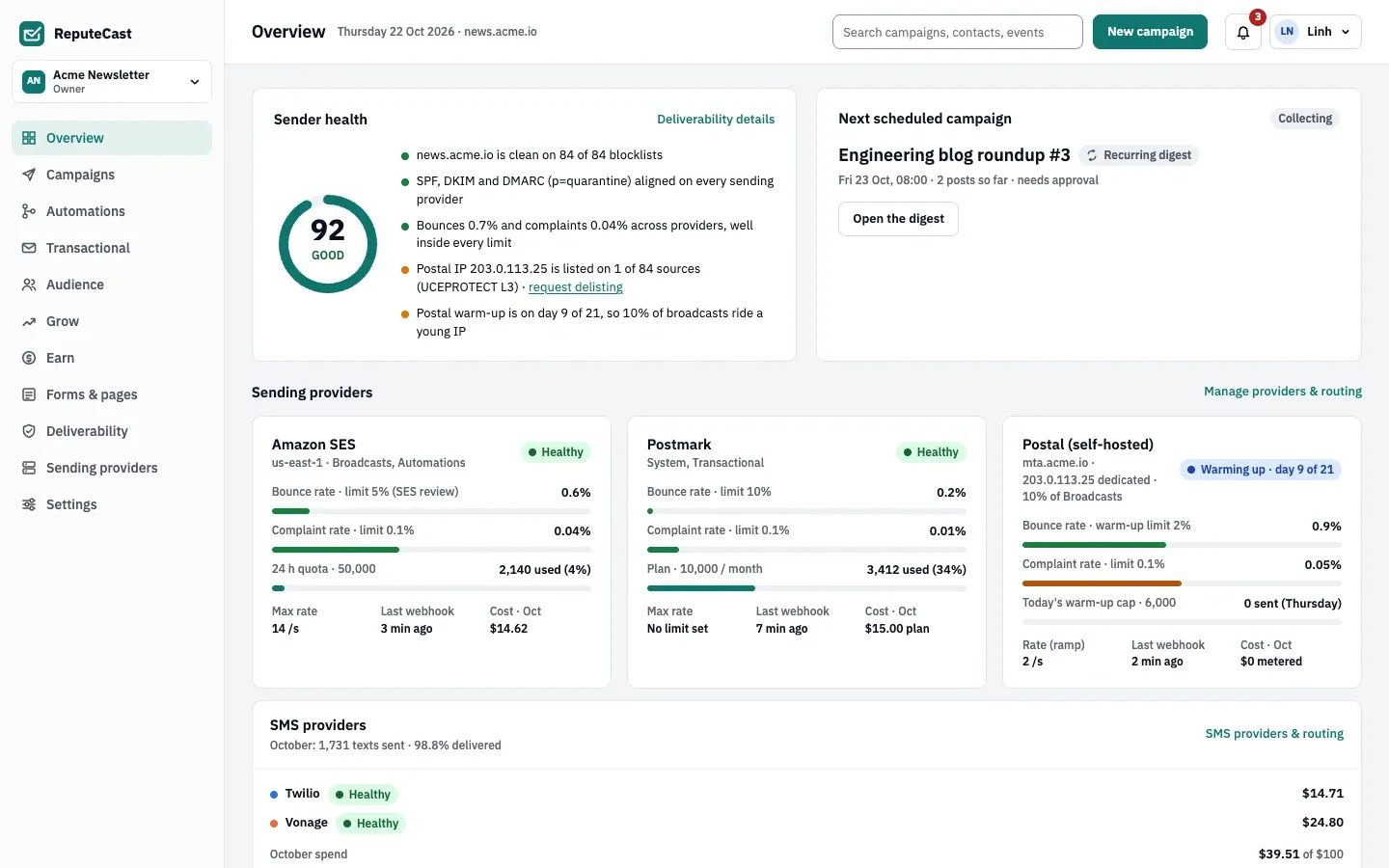
- Sender health: blocklists, authentication, bounce and complaint rates and warm-up in one score.
- The next scheduled campaign and what it still needs.
- Each connected sending provider with its status.
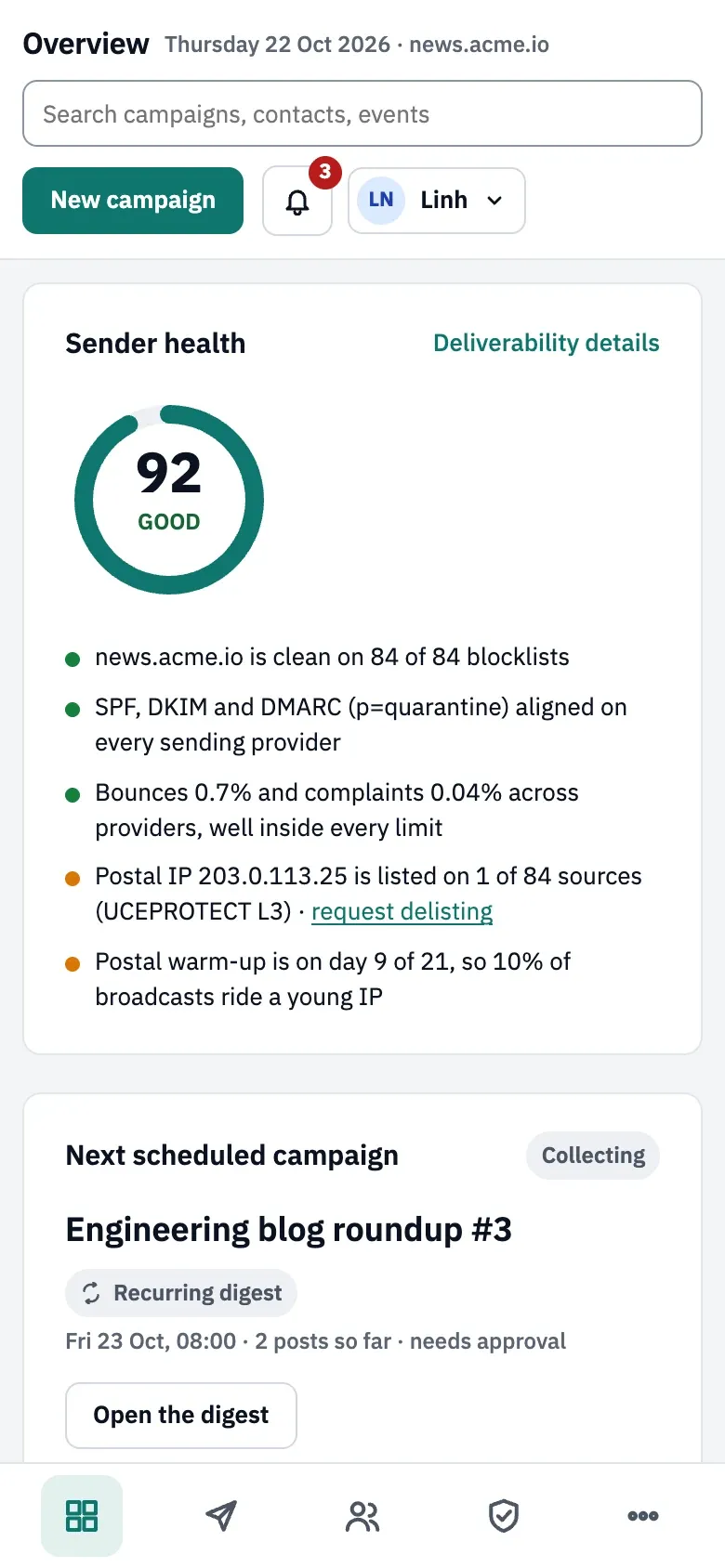
The app works on a phone too, with a tab bar for Overview, Campaigns, Audience, Deliverability and more:
Any sending provider, several at once
Section titled “Any sending provider, several at once”ReputeCast has built-in adapters for Amazon SES, Postmark, Mailgun, SendGrid, Resend, SparkPost, Mailjet, Brevo, Azure Communication Services, your own Postal server and any SMTP server, plus a generic HTTP adapter for other email APIs and community adapters that run in their own process. Compare them in Choose a sending provider.
You can connect several providers at once. A route decides which provider delivers each email, by kind of mail, list, sender domain or the recipient’s mailbox provider, with weighted splits and failover. Every provider’s bounces and complaints land in one suppression list, so a bounce at one provider stops mail to that address everywhere. Read How ReputeCast works.
Every feature is free
Section titled “Every feature is free”ReputeCast is licensed under the GNU Affero General Public License v3.0 (AGPL-3.0). There is no paid edition, no seat limit and no workspace limit, and nothing in the app waits behind an upgrade prompt.
What you can do with it
Section titled “What you can do with it”| Area | What it covers |
|---|---|
| Campaigns | Drag-and-drop composer on MJML, Liquid personalization, A/B tests, conditional content, polls, languages, RSS digests. |
| Audience | Contacts, lists with consent evidence, segments, list health, suppressions, imports, scoring, address verification. |
| Automations | Visual flows with triggers, delays, branches, A/B splits and goals. |
| Transactional email | Templates, a send API with idempotency keys, a message log and an SMTP relay. |
| Forms and pages | Signup forms, preference center, unsubscribe and archive pages, a newsletter website and landing pages. |
| Grow and Earn | Referral programs, recommendations, paid subscriptions through Stripe, gifts, sponsorships and digital products. |
| SMS, push and WhatsApp | Text messages, web push notifications and WhatsApp messages next to email. |
| Deliverability | Domain, IP and provider health, blocklists, DMARC reports and inbox placement tests. |
| Developers | REST API, webhooks, an MCP server for AI agents, integrations and provider adapters. |
| Team and security | Unlimited workspaces, roles and permissions, approvals, two-factor sign-in, single sign-on, an audit log, agency clients. |
Who it is for
Section titled “Who it is for”- Publishers and creators who want their newsletter, website and paid subscriptions on infrastructure they control.
- SaaS founders who send product updates, onboarding automations and transactional email from one place.
- Marketing teams leaving a hosted email platform who want to keep their consent records and choose their own sending provider.
- Agencies that run client workspaces with approvals and per-client usage.
You run ReputeCast yourself, so someone on the team needs to be comfortable with Docker or a Linux server. Start with the quickstart, or read the system requirements.
HostRepute is optional
Section titled “HostRepute is optional”Every check in ReputeCast works without a HostRepute account. If you connect HostRepute, it adds more blocklist sources, Google Postmaster Tools, Microsoft SNDS data, DMARC reports and alerts. ReputeCast sends it only your sending domains, your dedicated IP addresses and any server you add to monitoring; it never sends contacts, email content or campaign statistics.
How it is built
Section titled “How it is built”One reputecast binary serves the web app, the REST API, public pages, provider webhooks and the MCP server, runs
background jobs in PostgreSQL, and hands mail to your sending providers.
The binary runs on Linux, macOS and Windows, or as a Docker image. PostgreSQL is the only other service it needs. For larger installations you can run the web, ingest and worker roles as separate processes; see Scale with web, ingest and worker roles.